EVPS Software & Modules
Run your abuse desk on evidence, not on a shared inbox.
Every abuse complaint, bug report, feature request and piece of customer feedback lands in one case queue inside WHMCS, arrives with tamper-evident evidence already attached, and reaches an action only after a policy and a human have both agreed. Nothing is terminated automatically, under any configuration.
An abuse desk you can still defend six months later
Most providers run abuse out of a mailbox and a couple of forwarding rules. That arrangement fails in predictable ways: no evidence you can hand over, no consistency between two engineers meeting the same report, no brake on a malicious reporter, and no channel back to the person who told you.
Evidence that survives the argument
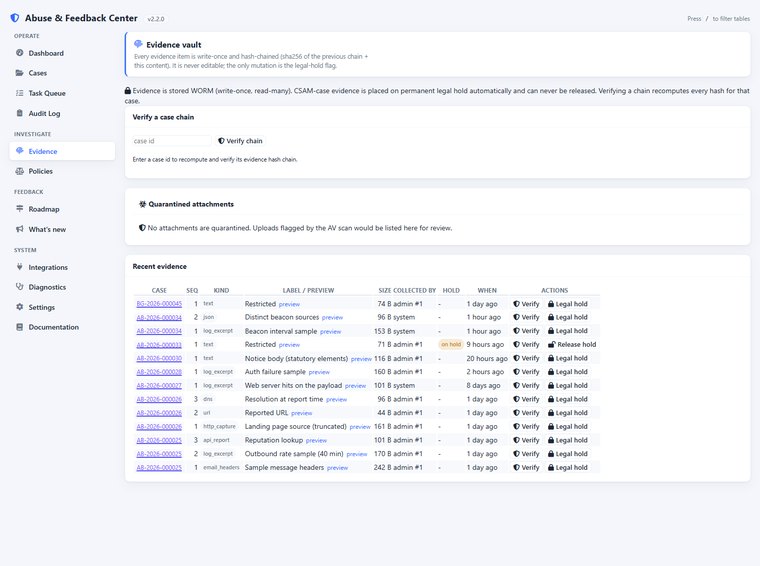
Every case carries a write-once evidence vault with its own SHA-256 hash chain, keyed with an install secret. Chain verification is a button in the admin area. There is exactly one delete path and exactly one update path · content columns are never rewritten.
A policy and a human, in that order
Confidence scoring and a per-stream, per-category response policy produce a recommendation. The orchestrator executes it only after approval, and re-checks every threshold and kill switch at execution time rather than trusting the approval it was given earlier.
No automatic terminations, ever
There is no termination code path in the module. The termination action opens a high-priority review ticket for a human to act on inside WHMCS. Suspension can be automated, but only once you have deliberately armed four separate switches.
The loop actually closes
Anonymous reporters get a no-login status page. Customers get a public roadmap with voting, a “What’s new” changelog and satisfaction capture, so bug reports and feature requests stop disappearing into a mailbox nobody reads twice.
Everything the module adds
Four intake streams, a twelve-tab admin command centre, six client-area pages and sixteen orchestrated action types. Every item below is implemented in the shipped code.
Four intake streams
Abuse, feedback, feature requests and bug reports share one case model, one audit trail and one SLA clock · each with its own category list, guided description template and response policy.
Public intake, no login
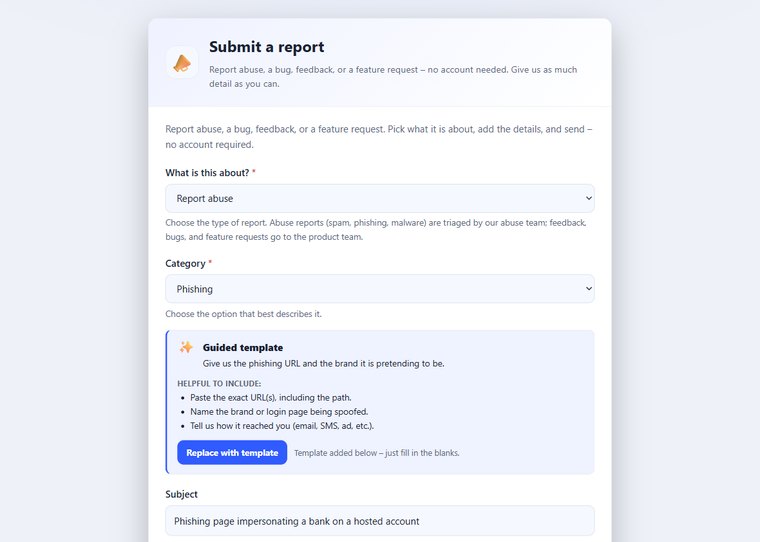
A self-contained report form accepts all four streams from anyone, works without JavaScript, and passes an ordered gauntlet of switches, honeypot, optional Turnstile, reporter reputation and per-IP rate limits before anything is written.
No-oracle status lookup
Reporters check a case with its reference and the email they used. A wrong reference, a wrong email and a reference that never existed all return the identical neutral answer, and the target is never shown.
WORM evidence vault
Insert-only storage with a per-case SHA-256 hash chain, on-demand verification, legal holds, content scrubbing and hard caps. Attachments flagged by the upload scan are reviewed in quarantine and never rendered as a thumbnail.
Confidence scoring
A 0-100 score built from named, inspectable factors: source weight, reporter reputation, corroboration from distinct reporters, an AbuseIPDB score where configured, a fraud-suite risk signal, and whether the named target is genuinely one of yours.
Response policies
One editable policy per stream and category: severity, SLA windows, recommended actions, the confidence and severity thresholds for automation, and an explicit allow-auto-suspend switch. Import and export as JSON.
Action orchestrator
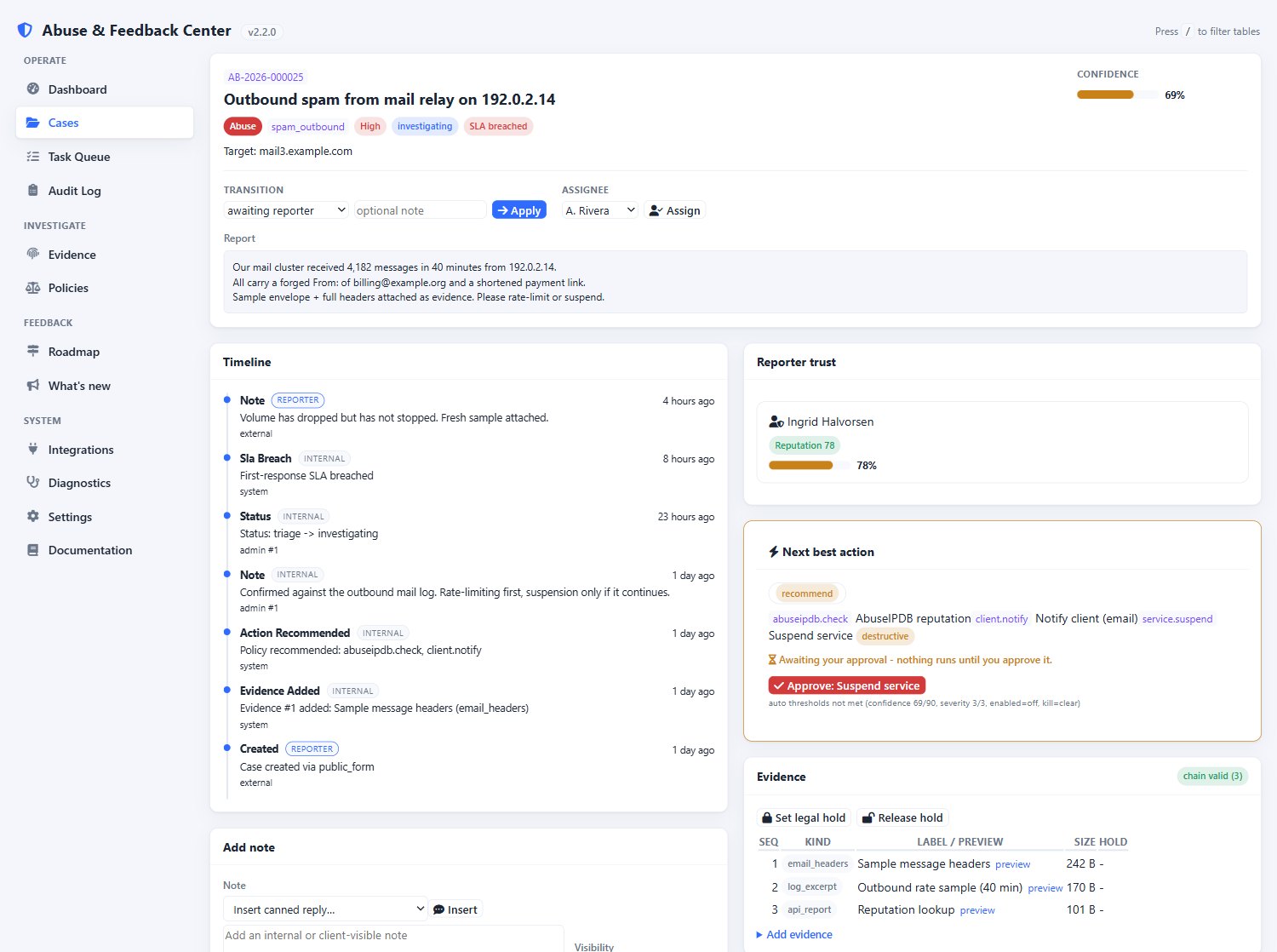
Sixteen action types move through recommended, approved, queued, running and succeeded or failed, each declaring whether it is reversible and whether it is destructive. Reversible actions record the reference they created, so one click undoes them.
Split-view triage
A filterable case rail beside full case detail with no page reload · keyboard navigation, a command menu, a next-best-action rail, quick-assign, bulk operations, canned-reply macros, suggested duplicate merges, appeals and CSV export.
Durable task queue
Ten handler types drain through the WHMCS cron or a standalone worker. Tasks are claimed with a conditional update so both can run side by side and nothing executes twice; the console shows depth, retries and cancellations.
SLA & escalation
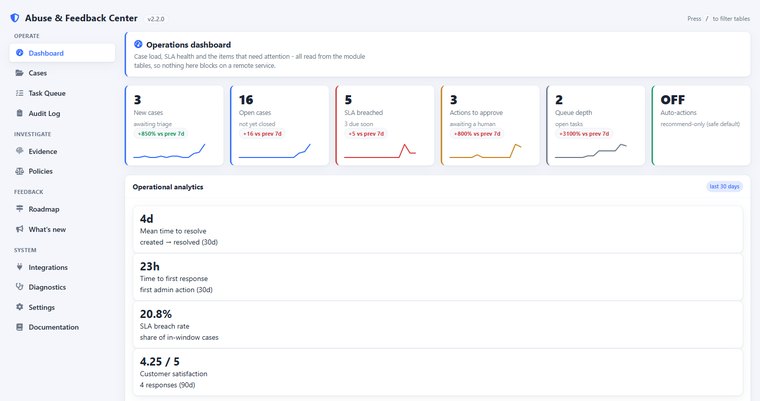
Per-policy SLA windows with hourly scans and due-soon and breached states, mean time to resolve, time to first response, breach rate, admin escalation and a daily digest.
Roadmap, changelog & CSAT
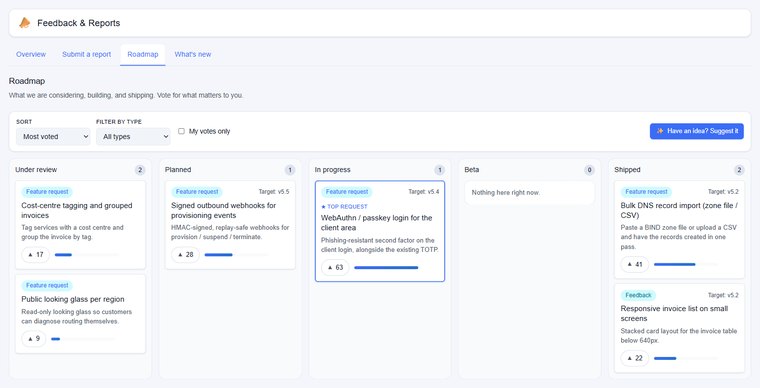
A public roadmap with client voting, moderated comments and follows; a tagged “What’s new” changelog linked to the items it shipped; and satisfaction capture on resolution.
Client portal, six pages
Overview, a three-step submit wizard, case detail with a lifecycle stepper and appeals, roadmap, roadmap item and changelog · rendered inside your active WHMCS theme from a translatable language pack.
Ten probed adapters
WHMCS tickets and module actions, notifications, a fraud-suite signal, Proxmox, Cloudflare, AbuseIPDB, GitHub, GitLab and OpenProject. Each is probed read-only, and its actions stay off the menu unless the probe says it is usable.
Webhooks & chat-ops
Outbound case-lifecycle webhooks signed with a per-endpoint HMAC, delivered with retries, a delivery log, per-delivery redelivery and a dead-letter path · plus an opt-in Slack, Teams or Discord mirror.
Abuse mailbox intake
Polls an IMAP mailbox into cases with X-ARF and classic ARF report parsing, and skips any message whose Authentication-Results header records an explicit DKIM or SPF failure.
AI triage, advisory only
Suggests a category, severity and summary and can summarise evidence, validated against the module’s own vocabulary. It never transitions a case, changes a field or executes an action.
Diagnostics & audit trail
Health cards for PHP, extensions, all 32 schema tables, migrations, the secret-vault round-trip, queue depth and cron activity, plus an append-only trail of every authorized and denied action with CSV and JSON export.
Emergency controls
Twelve feature flags, seven of them kill switches: block all mutations, actions, automatic actions, public intake, external sync, notifications and chat-ops. Flips take effect immediately, and the admin panel stays reachable even with the module disabled.
Your team and your reporters
Captures from a live installation · the admin console, the client portal and the public form.
How to install & run it
- Install. Upload to modules/addons/evps_abuse_center and activate under Configuration → Addon Modules. Activation runs three idempotent migrations, creates 32 dedicated tables, seeds one conservative policy per stream and category and writes default settings. Re-activating is safe.
- Licence. Paste the key issued at checkout. The module validates against this store and caches the result, so it does not call out on every request. If our licensing service is unreachable it keeps working through a grace period and warns an administrator instead of taking your abuse desk offline.
- Configure. Set the alert email, the default ticket department and your retention horizons, and leave Automated Actions off until you trust your policies. Automatic action lists ship empty, so day one is fully manual by construction.
- Connect (optional). Add credentials for the integrations you want and press Test on each card. Test runs the same read-only connectivity probe the module uses itself · it confirms the credentials and the endpoint, not that a mutating call will succeed.
- Pick a queue mode. The WHMCS cron by default, or the standalone worker on a one-minute cron. Both can run side by side without a task ever executing twice.
- Operate. Diagnostics, the queue console and the audit log show what is happening. Hourly SLA scans, daily digests, retention sweeps, capability re-detection and health checks are wired to the WHMCS cron hooks out of the box.
Protected, licensed, supported
ionCube protected
Two lanes: ic14 for ionCube Loader 13.3.1 and 14.4.1 on PHP 8.2 and 8.3, and a legacy ic13 lane for PHP 8.2 only. A readable preflight runs before any protected code, so a wrong Loader produces an actionable message rather than a blank page.
Properly licensed
One licence per WHMCS installation, bound to the domain, IP and directory you install on and reissuable from your client area when you migrate. Apart from the licence check-in, the module calls out only to integrations you configure yourself.
Credential-safe
Integration secrets are encrypted with AES-256-GCM under a key derived from your WHMCS encryption hash, with a per-value IV, an authentication tag and additional data binding each blob to its own row. Secrets are never logged, never echoed back into a form and never placed in an error message.
Supported
Support and updates run with your licence type: for as long as a Subscription runs, twelve months on a One-Time licence, and for the life of the product on a Lifetime licence. Every release ships a changelog, a per-file manifest and a SHA-256 checksum.
Compare the three licences
One build, all features. There is no feature gate anywhere in the code and no cut-down edition · the tiers differ only in how you pay and how long updates and support are included.
| Subscription $24.95 /mo · $99.00/yr | One-Time $149.00 one-time | Best value Lifetime $299.00 one-time · Founding 100 | |
|---|---|---|---|
| Complete feature set | |||
| WHMCS installations | 1 | 1 | 1 |
| All four intake streams | |||
| Evidence vault & hash chain | |||
| Policy engine & action orchestrator | |||
| Client portal, roadmap & changelog | |||
| All adapters & integrations | |||
| Runs once the term ends | While active | Perpetually | Perpetually |
| Updates | While active | 12 months | For the life of the product |
| Support | While active | 12 months | For the life of the product |
| Licence reissue on migration | |||
| Billed | Monthly or yearly | Once | Once |
| Refund | 30 days, defect | 30 days, defect | 30 days, defect |
Requirements
WHMCS
8.13 or 9.0
PHP
8.2 · 8.3
ionCube Loader
13.3.1+ (14.4.1 recommended)
Database
MySQL 5.7+ or MariaDB 10.3+
Extensions
curl, openssl, json
Cron
WHMCS cron or a one-minute worker
Frequently asked questions
Can it suspend or terminate a customer automatically?
Which features ship switched off?
Does the CSAM workflow report to NCMEC for me?
Which integrations need my own credentials?
Does it modify WHMCS core tables?
Can an anonymous reporter discover whether one of my customers is under investigation?
What happens if an integration or a remote service goes down?
What happens if your licensing service is unreachable?
Which ionCube package do I download?
Do I have to expose a public form?
Recent updates
Choose your licence
Same complete module in every tier · the only difference is how you pay and how long updates & support last.